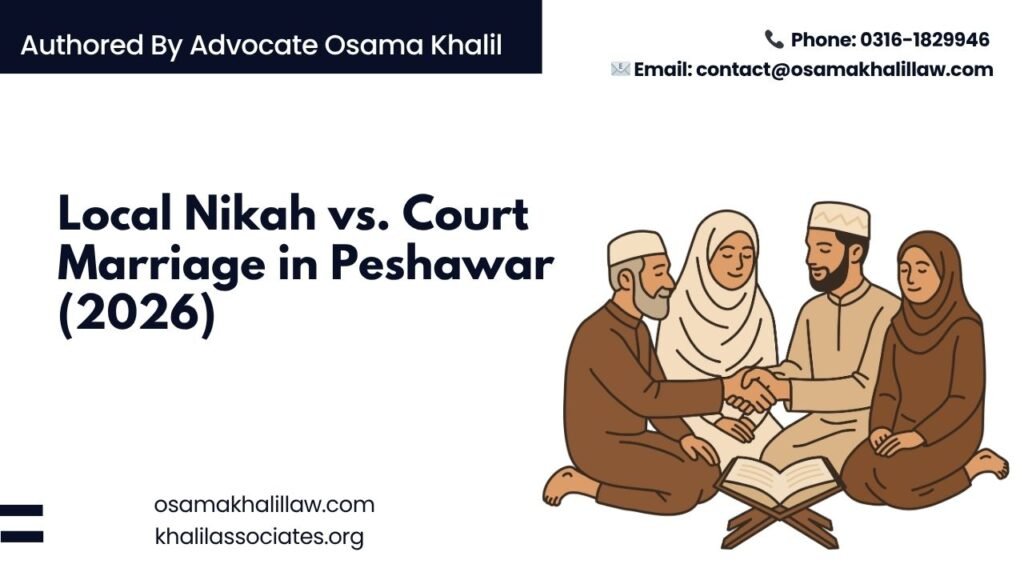
Understanding the difference between a local Nikah Khwan and court marriage in Peshawar is essential for couples seeking legal certainty. In 2026, both methods utilize the same “Nikah Nama” document, but the procedural background differs significantly. A local Nikah is typically a social and religious event conducted at a home or mosque. Conversely, a court marriage is a legal strategy used primarily to secure “Free Will” protection through the judiciary. Because the Peshawar High Court strictly monitors family law, a court marriage provides an extra layer of defense against false kidnapping charges. Furthermore, the 2026 digital updates require both types to be registered with the Union Council to obtain a NADRA certificate. By knowing these differences, you can choose the path that best suits your safety and social needs.
1. The Local Nikah Khwan (Traditional Marriage)
The traditional route involves a local Nikah Khwan (a licensed religious registrar) who visits your location.
- The Venue: Usually, this ceremony takes place at a residence, a marriage hall, or a local mosque.
- The Role: The Nikah Khwan recites the sermon and fills out the four copies of the Nikah Nama. He is legally responsible for submitting one copy to the Union Council.
- Social Nature: It is a public declaration involving family members and witnesses. However, it does not involve a judge or a formal statement in a courtroom.
2. The Court Marriage (Legal Protection Route)
In contrast, a court marriage in Peshawar is designed for couples who may face family opposition or safety risks.
- The Judicial Statement: The defining feature of this route is a “Statement of Free Will” recorded under Section 164 of the CrPC before a Magistrate. This statement proves the bride is not being kidnapped.
- The Venue: The process starts at a lawyer’s office and ends in the District Courts of Peshawar. A licensed Nikah Khwan still performs the religious ceremony, but it happens under legal supervision.
- Protection from FIRs: If a family files a “kidnapping” case, the court marriage documents act as an immediate defense. Therefore, the police cannot arrest the groom once the judicial statement is verified.
| Feature | Local Nikah Khwan | Court Marriage |
|---|---|---|
| Primary Goal | Religious & Social Union | Legal Safety & Protection |
| Judicial Involvement | None | Statement before a Magistrate |
| Lawyer Needed? | Not usually | Highly Recommended |
| Police Protection | No automatic protection | 164 CrPC statement stops FIRs |
| Final Document | NADRA Marriage Certificate | NADRA Certificate + Court Order |
3. Registration and Validity in 2026
Regardless of the method, the legal validity of marriage in Peshawar depends on state registration.
- Union Council Filing: Both the local Nikah Khwan and the court marriage lawyer must file the Nikah Nama at the Union Council.
- NADRA Integration: In 2026, the Union Council secretary uploads the data to the NADRA CRMS system. Consequently, you can verify your marital status via the Pak-ID app within days.
- International Use: For visa purposes, both types are equally valid. However, embassies often prefer court marriage documents if the union was unconventional or lacked traditional family presence.
2026 Compliance Checklist
Mahr (Dower): You must specify the Mahr amount in Column 13 of the Nikah Nama. In 2026, clearly stating “Prompt” (Muajjal) or “Deferred” (Ghair Muajjal) is mandatory to prevent future disputes.
Local Nikah vs. Court Marriage in Peshawar (2026):
Age Requirements: In Peshawar, the groom must be 18 and the bride must be 16. The Nikah Khwan will verify these ages using CNICs or B-Forms.
Witnesses: You need two adult Muslim male witnesses with valid CNICs for either procedure.
Legal Assistance
For professional legal guidance and support in Tax Matters, you may contact:
Lawyer & Legal Consultant
📞 Phone: 0316-1829946
📧 Email: contact@osamakhalillaw.com | contact@khalilassociates.org